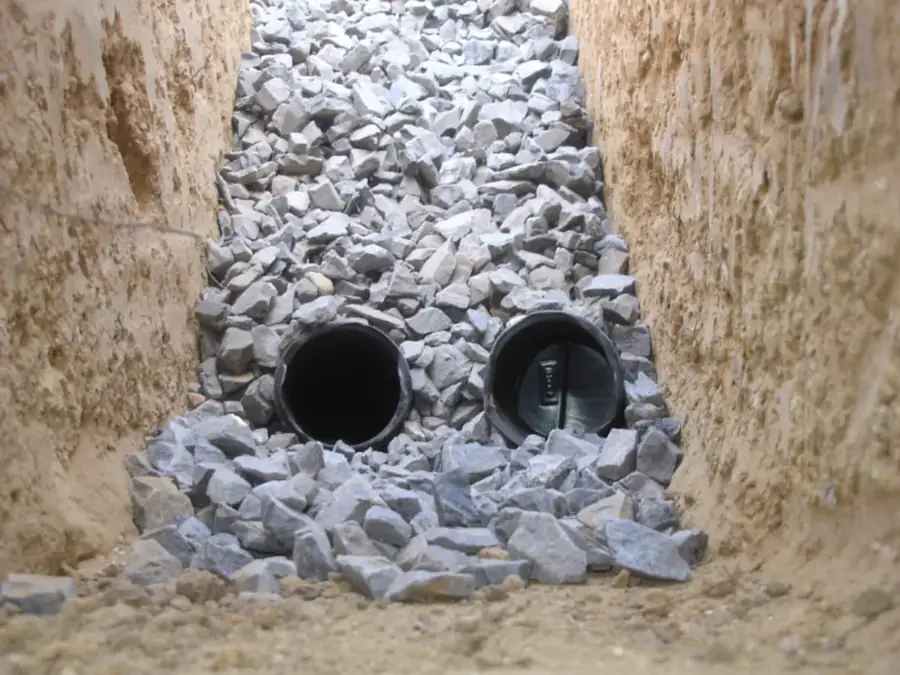
Retaining Wall Drainage in McDonough: What It Is and When You Need It
McDonough Drainage connects homeowners with a vetted local contractor for retaining wall drainage in McDonough and around Henry County: the clean stone, filter fabric, perforated pipe and outlets that let water escape from behind a wall instead of building up against it. Nearly every wall that holds back soil needs this, and on red clay lots the drainage decides how long the wall lasts more than the block does.
You need it built into any new wall, and added to an existing one that shows trouble: a face that leans or bellies outward, muddy water seeping from the joints after storms, weep holes that stay dry when the ground behind is soaked, or soil washing out at the base.
Why Retaining Walls Fail in Red Clay
Walls in Henry County fail mostly because water gets trapped in the clay behind them. Cecil clay drains very slowly, so after a summer storm the soil behind a wall stays saturated for days, and that wet soil is far heavier and pushes harder than the dry soil most simple walls are sized for. Add water pressure from a full, undrained backfill and the wall is fighting a load it was never built for.
The clay is also what a builder digs up and puts back. Generations of row-crop farming stripped the topsoil from Piedmont fields, according to USDA Agricultural Research Service work, leaving dense, high-clay subsoil exposed across much of the region. Using that red clay as backfill straight against the block, with no stone zone, is a common shortcut, and it puts the wettest, heaviest soil on the lot directly against the wall.
The third cause is silt. Without filter fabric between the clay and the drainage stone, fine clay particles wash into the gravel and slowly fill it, so a wall that drained well for its first few years quietly stops draining.
What Retaining Wall Drainage Costs
Adding drainage behind an existing wall costs about $60 to $70 per linear foot where the soil behind it can be dug out, according to Fixr's retaining wall cost guide. On a new wall the stone, fabric and pipe are part of the build price, which Fixr puts at roughly $30 to $50 per square foot of face for a concrete block wall.
Price depends mostly on access and on whether the wall can stay up while the backfill is removed. A wall with open yard above it can be dug out from behind with a small excavator. One with a patio, fence footings or a driveway right behind it has to be opened by hand in short sections, and a wall that has already rotated too far isn't worth draining; it gets rebuilt, which costs far more than either. Fixr's guide is at fixr.com.
The Parts of a Retaining Wall Drainage System
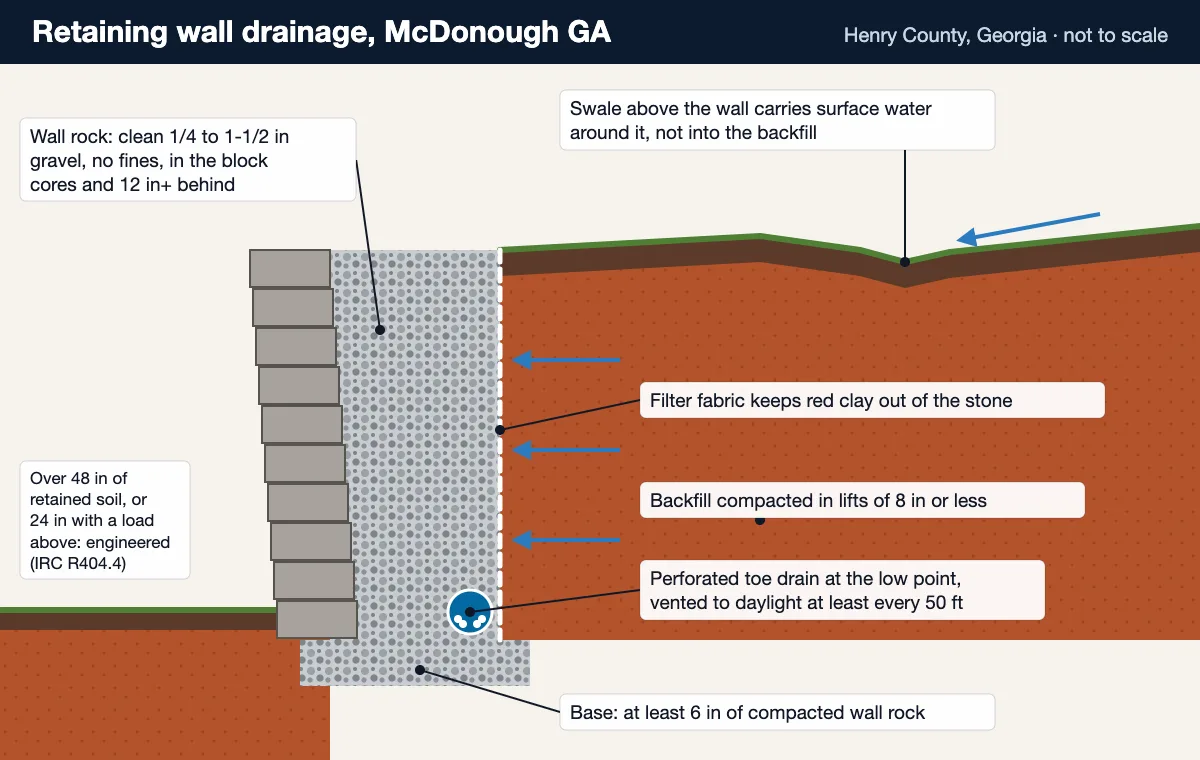
A zone of clean, angular wall rock fills the cores of hollow block and extends at least 12 inches behind the wall for its full height, per Allan Block's installation guide. It relieves pressure by giving water somewhere easier to go than through the wall.
Geotextile between the stone zone and the clay backfill keeps fine soil from migrating into the gravel. Against Cecil clay this is the layer that decides whether the drainage still works in ten years.
A perforated pipe at the lowest point toward the back of the base trench collects what the stone sends down. Allan Block calls for one on gravity walls over 4 feet, all reinforced walls, walls with slopes or other loads above them, and sites with poorly draining soil, a description that fits most Henry County lots.
The toe drain has to vent to daylight or a lower part of the site at least every 50 feet, or exit through the face with tee fittings at 30 to 50 foot intervals. Poured concrete and masonry walls get weep holes through the face, and those have to be kept clear.
Soil behind the stone zone goes in lifts of no more than 8 inches, each compacted with a plate compactor. Loose fill settles, opens gaps and lets surface water run straight down behind the wall.
The stone and toe drain are built for incidental water, not a yard's worth of runoff. A graded swale or cap along the top of the wall steers surface water around it.
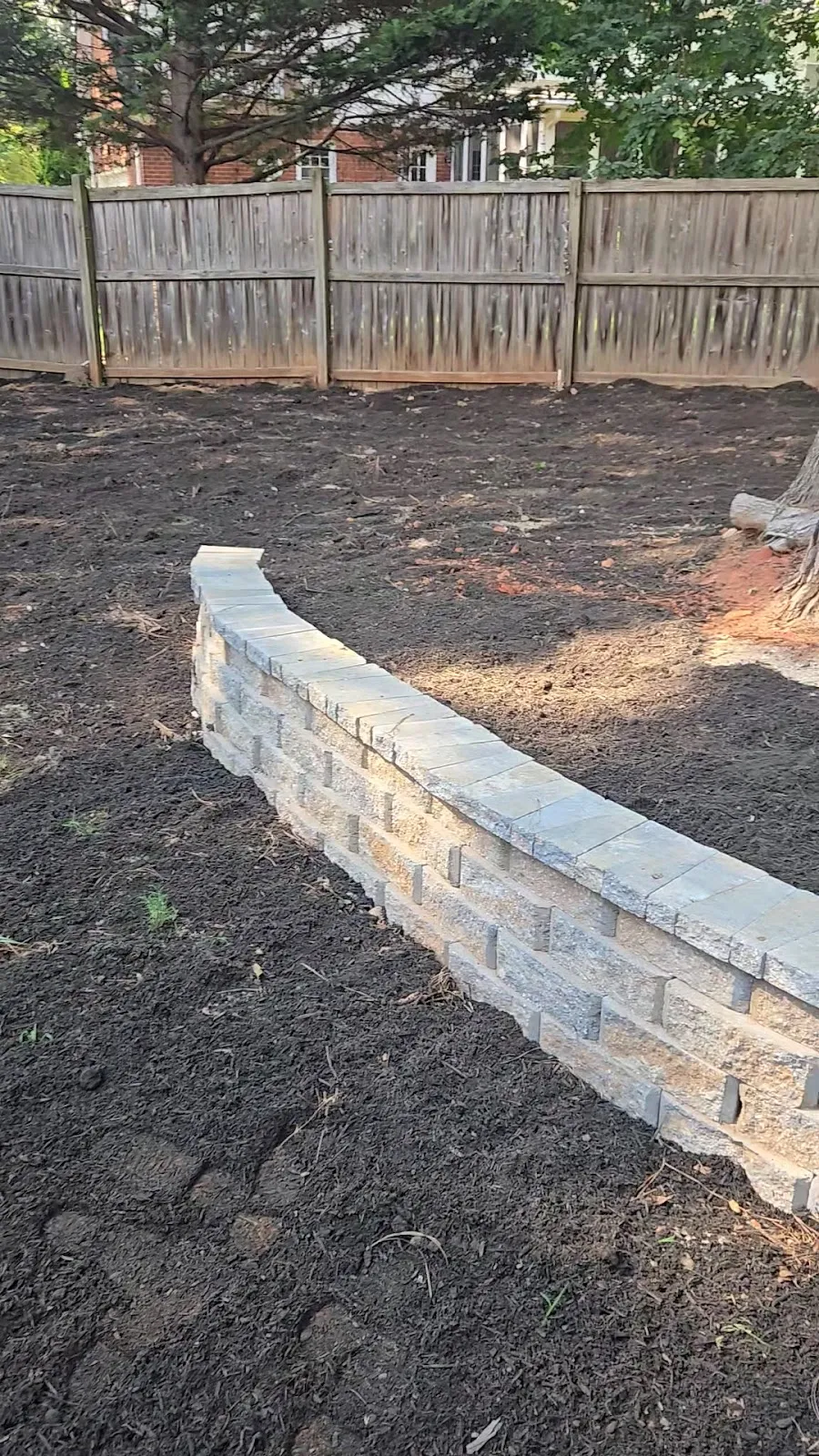
Recent project from our featured contractor
Finish grading behind a new block retaining wall, from our featured contractor's own job photos.
The photo shows fresh soil spread evenly across the yard behind a curved, capped block wall.
Getting the slope right across a yard is what keeps water moving away from the house instead of pooling against it.
Chris E. hired him to grade for an arena at their farm and wrote that [our contractor] “listened to what I wanted and absolutely delivered with great work.”
When a Wall Needs an Engineer
A wall that retains more than 48 inches of soil, or more than 24 inches when it also carries another load such as a driveway or parked cars above it, has to be engineered under Section R404.4 of the International Residential Code. The design must account for overturning, sliding, pressure on the foundation and water uplift, with a safety factor of 1.5 against sliding and overturning.
Unbalanced fill means the difference in soil height between the two sides of the wall, so measure from the ground in front to the ground behind, not by counting visible courses. Check with the Henry County Building & Plan Review Departmentbefore building anything near that size, and remember that the digging itself falls under the county's land disturbance permit once it passes 120 square feet.
Adding Drainage to an Existing Wall
Draining an existing wall means opening the ground behind it. The usual method is to excavate in short sections so the wall is never fully unsupported, line each section with fabric, place stone and a perforated pipe at the base, and backfill in compacted lifts before moving to the next stretch.
Poured concrete walls with no weeps can be core-drilled near the base to give trapped water an exit, though without stone behind them those holes only drain the soil right around each opening. Whatever is done behind the wall, the surface above it gets regraded so water stops pouring over the top or soaking in along the back edge.