French Drains and Yard Drainage Problems in Locust Grove
Locust Grove has grown fast. The town's population rose 65.6% between 2010 and 2020, to 8,947, and the 2025 estimate is 14,610. That means a large share of homes sit on subdivision lots graded within the last fifteen years, and new grading is where Henry County drainage trouble starts: fill that settles, sod laid over subsoil, and lots stepped down a hillside so each one drains across the next.
The soil adds to it. USDA maps around town include Appling sandy clay loam and Gwinnett sandy clay loam in their "eroded" phases, meaning much of the original topsoil washed off long ago and clay sits close to the surface. Rain soaks into a few inches of loose material, hits the clay and runs sideways downhill. On a lot below two or three others, that sideways flow surfaces as a permanently wet line along a patio, a fence or the foundation.
A french drain catches that seep where it surfaces. Locust Grove sits in the headwaters of the Upper Ocmulgee: USGS gauges near town measure Indian Creek draining 15.2 square miles and Tussahaw Creek draining 17.6. Small creeks like those carry yard runoff away quickly once it reaches them; the job is getting it there through a clay backyard.
What French Drains Cost in Locust Grove
Exterior french drains cost $25 to $40 per linear foot and interior systems $40 to $55, based on a Georgia contractor's published price guide. On newer Locust Grove lots the length is usually modest, because the problem is a wet line rather than a whole wet yard. What raises the price is finishing: irrigation lines, sod, edging and patio pavers that have to come up and go back down.
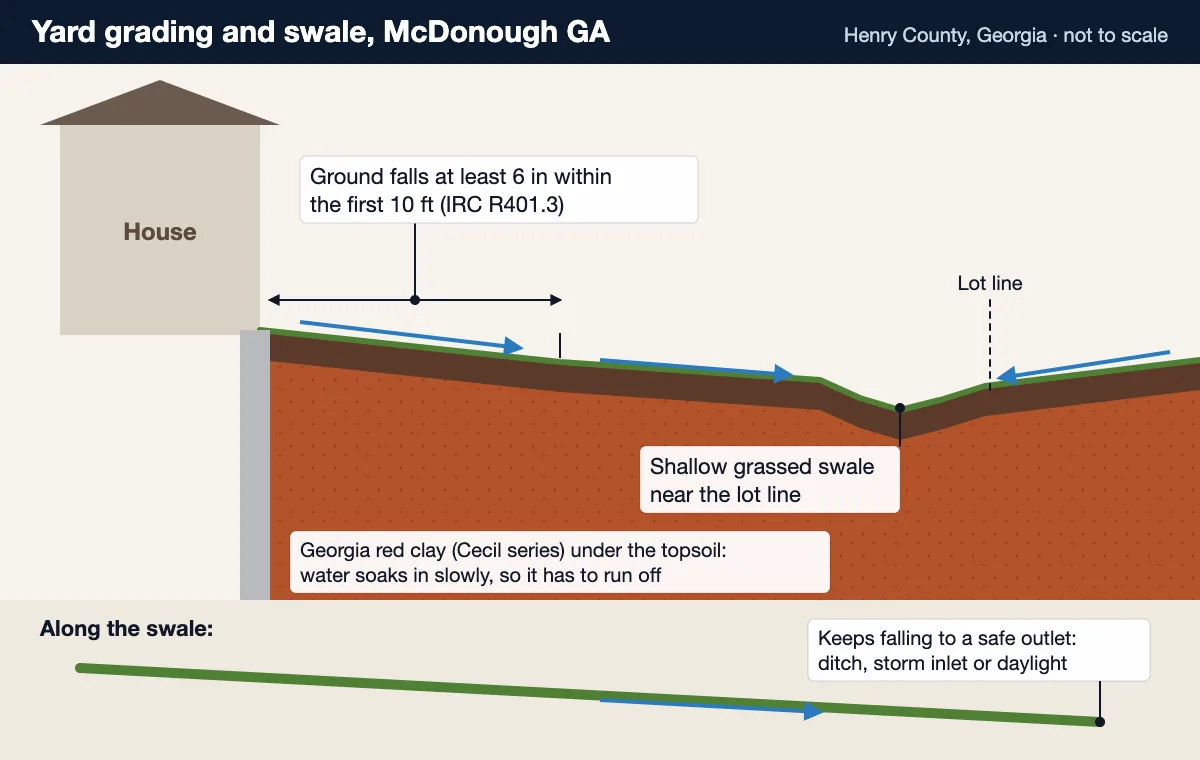
Ask whether part of the fix should be grading. Reshaping a shallow swale can take most of the surface water off the problem area for less than the equivalent length of pipe, leaving the drain to handle only seepage. A quote that offers only pipe, on a lot where water is plainly running across the surface, deserves a second opinion.
Permits Inside and Outside the City Limits
Locust Grove was incorporated in 1893, named for a grove of locust trees near the original town site, and it now covers 11.78 square miles around I-75 Exit 212 at Bill Gardner Parkway, US 23 and GA 42. Inside the city limits the city sets its own permit rules, so for whether a drainage or grading job needs a city permit, check with the City of Locust Grove before work starts.
Plenty of homes with a Locust Grove mailing address sit outside those limits in unincorporated Henry County. There, the county's Environmental Inspections and Complianceoffice applies. A property tax bill that lists city taxes is the quickest way to tell which side of the line you're on.