Why Foundation Drainage Matters in Henry County
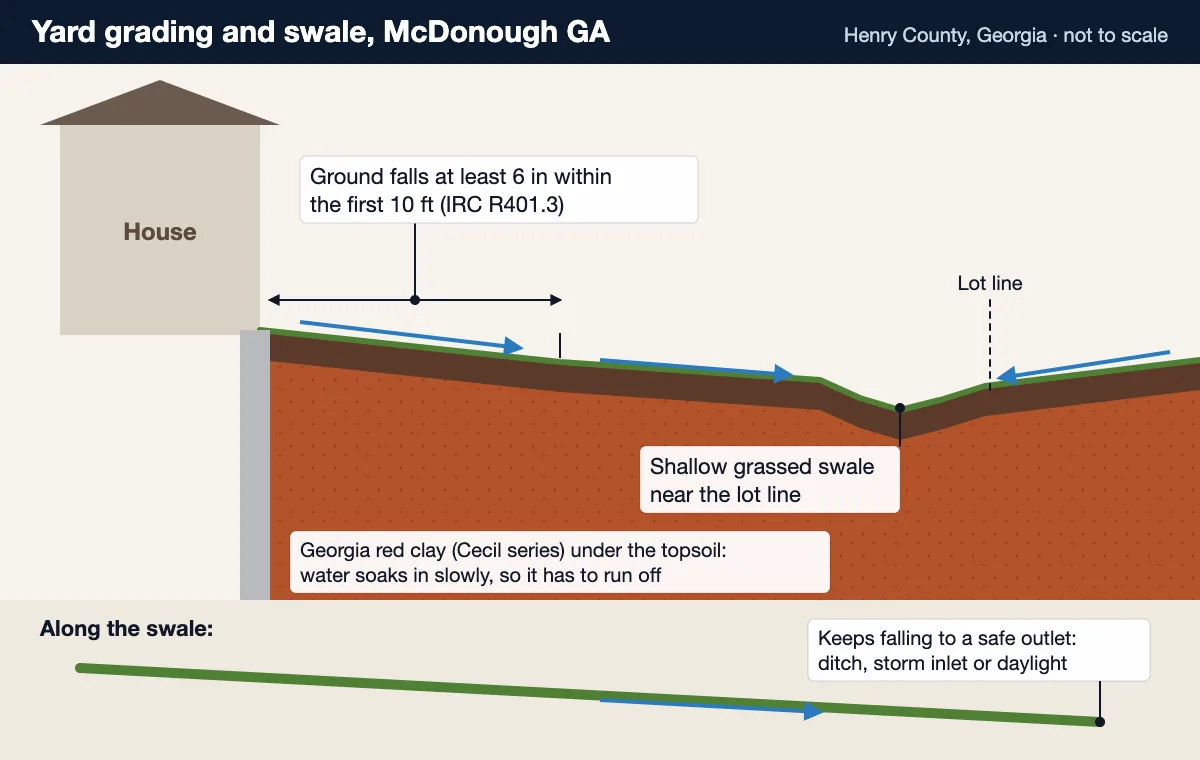
Georgia's Cecil red clay is classified as well-drained by the USDA, but that classification refers to how water behaves once it moves through the soil profile. The problem in Henry County is that movement is very slow. Cecil clay has low hydraulic conductivity. During heavy Georgia summer rain events, water saturates the ground, builds up against foundation walls, and exerts hydrostatic pressure that drives moisture through concrete, block, and any gap in the foundation envelope.
New construction homes in McDonough are particularly vulnerable. When the water table is high after heavy rainfall, improper backfill and inadequate original drainage allows water to accumulate in the soil surrounding the foundation. Without drainage to intercept it, that water eventually works its way inside.
Foundation drainage systems lower the water table around the structure by capturing water before it builds pressure and routing it away to a safe outlet.
Crawl Spaces, Not Basements: The Henry County Pattern
Most homes in McDonough, Stockbridge, and Hampton sit on a crawl space or a slab rather than a full basement, which is normal across the Georgia Piedmont and which changes where a water problem announces itself. A crawl space floor is usually bare Cecil clay sitting a few feet below outside grade, and it is the lowest point on the property that is enclosed. Water that saturates the soil around the stem wall works through block joints and mortar and then stands on that clay floor, where Georgia summer humidity gives it no realistic way to evaporate.
Homeowners often miss it for a year or more because nobody goes down there. The first symptom is usually upstairs: a musty smell that will not clear, hardwood cupping over one part of the house, or a persistently high humidity reading. By the time water is visible on the crawl space floor the subfloor and joists above it have already spent a season in damp air. On McDonough properties, the crawl space is a more reliable early indicator of a foundation drainage problem than any crack in the wall.
The fix follows the same logic as a basement, at lower cost. Perimeter drainage intercepts the water before or as it enters, the collected water goes to a sump or a daylight outlet, and a sealed vapor barrier stops what is left in the clay floor from evaporating into the framing. Skipping the drainage and installing only a vapor barrier is the common shortcut, and it traps standing water under the plastic instead of removing it.
Foundation Drainage Systems for McDonough Homes
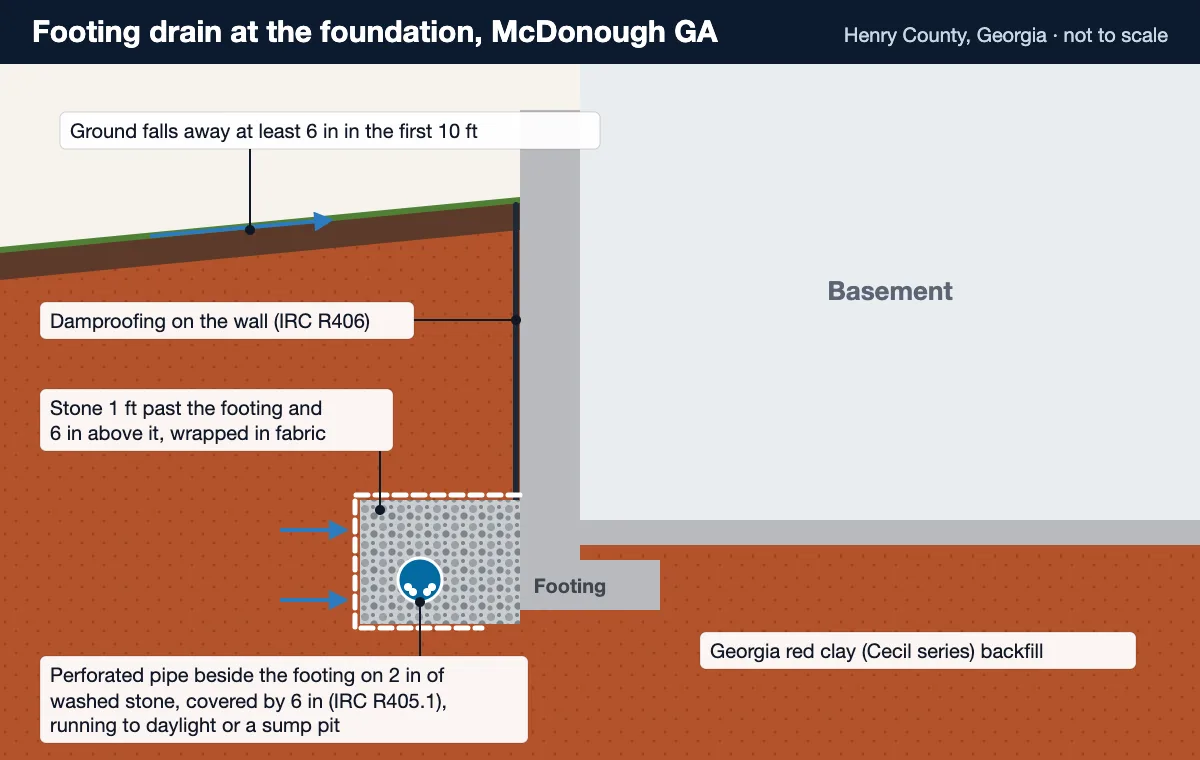
The most effective long-term solution. The trench is excavated to footing depth along the affected foundation walls, drain tile or perforated pipe goes in clean crushed stone wrapped in filter fabric, and collected water is routed away from the structure. Exterior drainage addresses the water before it reaches the wall.
For finished basements or when exterior excavation is impractical, an interior perimeter drain is installed along the inside of the foundation walls at the floor. Water that enters through the wall is captured and routed to a sump pit for removal. Interior installs in Henry County typically run $40 to $55 per linear foot.
Drainage tile installed in crawl spaces to collect water that enters through foundation vents or walls. Combined with a vapor barrier, crawl space drainage keeps Georgia humidity and groundwater from causing structural damage or mold in the crawl space.
Gutters that discharge too close to the foundation contribute directly to foundation moisture problems. Downspouts are extended to discharge water at least 6 feet from the foundation, eliminating one of the most common and easily corrected drainage problems in McDonough homes.
Signs Your Foundation Needs Drainage
- Water in the basement or crawl space after heavy rain
- Efflorescence (white mineral deposits) on foundation walls
- Musty odor in basement or crawl space
- Cracks in foundation walls with water staining
- Soil pulling away from foundation (dry periods) or pushing in (wet periods)
- Gutters discharging against or near the foundation wall
How to Decide Between Exterior and Interior
Recent project from our featured contractor
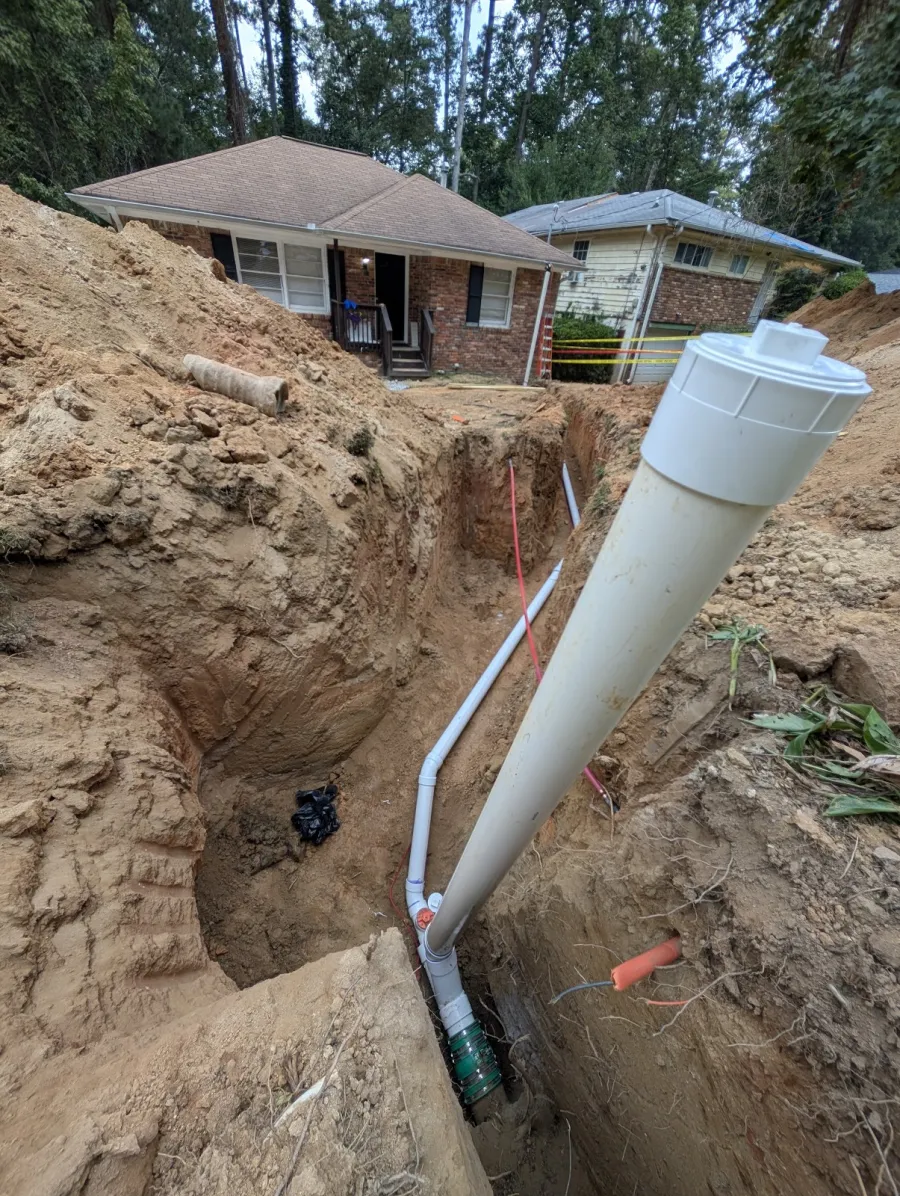
This is our featured contractor's own photo from a recent job: a clean, deep trench beside a brick home, with the pipe run laid along the bottom.
A capped cleanout comes up to the surface so the line can be flushed later without digging it back up.
In a Google review, Charlie F. wrote that [our contractor] “came out to my house within a day and completed trenching, grading, and concrete retaining wall removal in just 2 days.”
Exterior perimeter drainage is the better system when the site allows it, because it takes the water out of the equation before it ever touches the wall. The catch is access. It means excavating to footing depth along the affected walls, and on a McDonough lot that can mean lifting a patio, cutting through established landscaping, working within a few feet of a property line, or getting a machine into a back yard that has no side gate wide enough to take one. Where those constraints exist, the honest comparison is not exterior versus interior on merit, it is exterior plus restoration cost versus interior.
Interior perimeter drainage is the answer when exterior excavation is impractical or the home already has a finished basement worth protecting. A channel is cut at the floor and wall joint along the inside, perforated pipe is bedded and routed to a sump pit, and the pump lifts the water out to a discharge point outside. In Henry County that work runs $40 to $55 per linear foot, which is higher than exterior pipe per foot but usually involves far less site restoration. An interior system depends on a pump, which is why a battery backup belongs on any Henry County install: Georgia summer storms take power out at exactly the moment the pump is most needed.
Before either one, look at the cheap fixes. If the downspouts discharge a foot from the wall and the ground slopes back toward the house, extending the downspouts at least six feet and correcting the grade may solve the problem outright. That is often the case on older in-town McDonough properties where decades of added mulch and a repoured driveway raised the grade against the foundation. The perimeter is worth walking two or three days after a rain event, because a wall that is still damp once the surface water has cleared is telling you the source is subsurface and no amount of gutter work will reach it.
What Foundation Drainage Costs in McDonough
Interior perimeter systems in Henry County run $40 to $55 per linear foot, so a single 40-foot wall lands in the $1,600 to $2,200 range before the sump and pump, and a full basement perimeter is a different order of project entirely. Exterior perimeter drainage is quoted on excavation depth and access rather than a flat per-foot rate, since the difference between a three-foot crawl space stem wall and a full basement footing is most of the labor. Across McDonough homes, foundation drainage projects generally fall between $3,000 and $15,000 depending on how much perimeter is involved and which system the site allows.
Cecil clay pushes those numbers up relative to national cost tables, and it is worth knowing why before you compare quotes. Red Piedmont clay is dense, it loads heavy, and it does not break apart cleanly once it is wet, so trenching and spoil handling both run slower than a calculator built on sandy loam assumes. A Georgia figure and a national average are not measuring the same job.
The other thing that moves the price is where the water goes once it is collected, which is why foundation work is not quoted over the phone. Collecting water is the straightforward half. A sump discharge or gravity line needs a defensible outlet on your own property, and pushing concentrated runoff across a property line is a civil liability in Georgia regardless of how convenient the neighbor's slope looks. Two homes with identical wet walls and different outlet distances are not the same quote.
Permits and the Right Season for Foundation Work
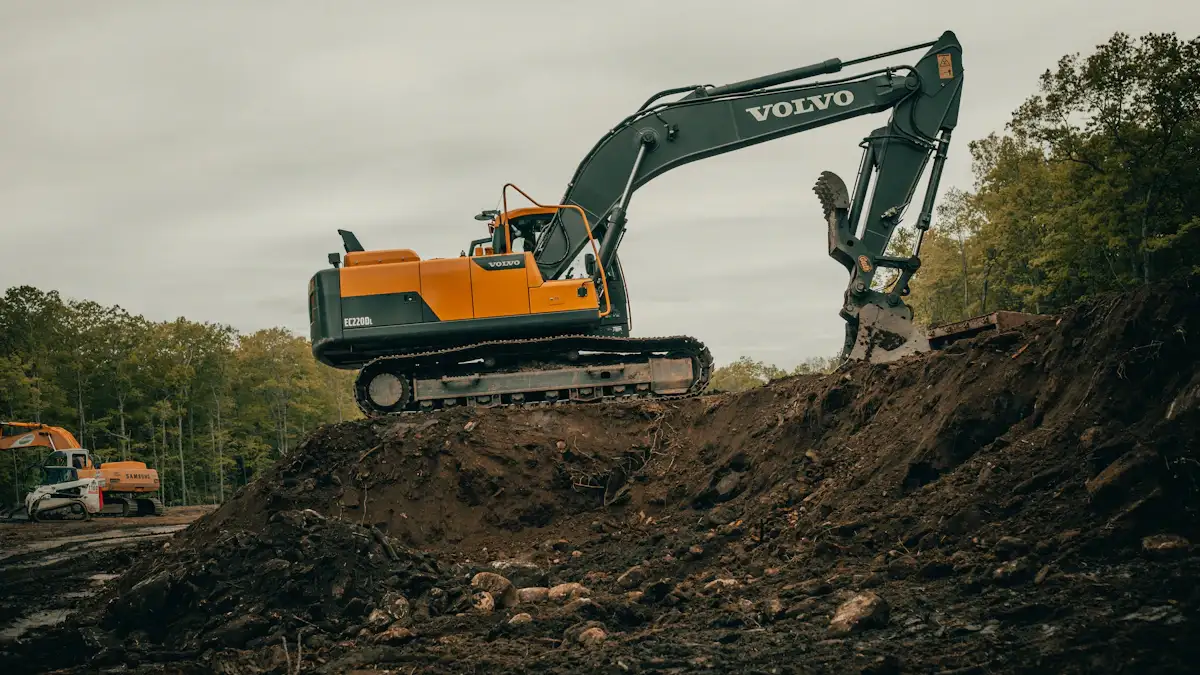
Henry County requires a land disturbance permit for any clearing, grading, or leveling over 120 square feet, roughly a 10 foot by 12 foot patch, which is one of the lowest thresholds in metro Atlanta. Excavating along a single foundation wall clears it comfortably, so assume exterior foundation drainage needs a permit. Applications go through the SagesGov portal and the reviewing office is Henry County Environmental Inspections and Compliance. Interior work inside an existing basement disturbs no land, but the discharge line that has to exit the building usually does. Full detail is on our Henry County permit guide.
On timing, October through December is the easiest window for exterior foundation work in McDonough. The clay has dried out from summer, trench walls hold their shape near a footing instead of sloughing, and any landscaping that has to be restored knits back in before the spring wet season. Most calls arrive in June through August because that is when the water is visible, and the work can absolutely be done then. It is just messier, the surface repair takes longer to look right, and the finished system performs exactly the same either way.