McDonough Drainage Co
McDonough, GA · Drainage Specialists

McDonough, GA • Henry County

French Drain Installation in McDonough, Georgia

Full exterior french drain systems built for Georgia's Cecil red clay soil. We trench, install, and route your drainage so Henry County's heavy summer rains stop backing up into your yard or foundation.

Free On-Site Estimates
811 Called Before Digging
Filter Fabric on Every Job
Henry County Permit Assistance

Signs You Need a French Drain in McDonough GA

Henry County's red clay doesn’t drain problems gradually — they accumulate quietly through the wet season and become obvious after one heavy summer storm. These patterns point to a french drain as the fix.

Standing water 48+ hours after rain

Cecil clay absorbs water at roughly 0.1 to 0.5 inches per hour. When Henry County's summer storms deliver 1 to 2 inches in an hour, the math is simple: the clay can't keep up. Water that sits for two days or more has nowhere to go and won't self-correct.

A yard zone that stays soggy between storms

A persistently wet area — soft underfoot, turf yellowing, roots rotting — means water is concentrating at that point from uphill grade, a neighbor's yard, or roof drainage. A french drain intercepts it at the source.

Water against or inside the foundation

Georgia red clay expands when saturated and pushes against foundation walls. Water at the foundation edge after summer thunderstorms is a warning. Water inside a crawl space means that warning went unaddressed too long.

Erosion channels cutting across the lawn

When runoff moves faster than the clay surface can absorb it, it cuts channels — and those channels deepen with every storm, carrying topsoil off your property. A french drain captures the flow before it reaches the surface.

Water in the garage or crawl space after storms

Sheet flow that finds its way under a garage door or into a crawl space isn't a sealing problem — it's a drainage problem. The water needs somewhere to go before it reaches the structure.

New construction home with drainage issues in year 1-3

Henry County is adding roughly 7,000 new homes per year. Builder grading passes code but regularly leaves low points near foundations or along lot lines that only reveal themselves in the first few rainy seasons. This is the most common source of french drain calls in McDonough.

Why McDonough Yards Have Chronic Drainage Problems

Henry County sits squarely on Georgia's Piedmont, where the Cecil clay series dominates the soil profile. Cecil red clay has very low hydraulic conductivity — roughly 0.1 to 0.5 inches per hour under field conditions. McDonough receives an average of 52 inches of annual rainfall, with the heaviest concentration in summer: July alone averages over 5 inches, arriving as intense afternoon thunderstorms that regularly deliver an inch or more within an hour. At that rate, the clay surface saturates within the first few minutes and the rest runs across the top, collecting in low points and against foundations.

Henry County is also one of metro Atlanta's fastest-growing counties, adding thousands of new homes per year along the I-75 and I-675 corridors south and east of the city. Rapid subdivision construction regularly leaves new homes with final grading that directs stormwater toward the foundation rather than away from it. These drainage problems often surface in years one through three, when settling soil and successive wet seasons reveal what the builder's grade actually does with water. The home passes inspection in dry conditions; the problem appears when it rains.

A properly installed french drain intercepts surface and subsurface water before it reaches your home. In Henry County clay, this means trenching to the right depth below the clay horizon, wrapping the system in filter fabric to prevent clay migration, and routing collected water to a reliable outlet where it can daylight safely.
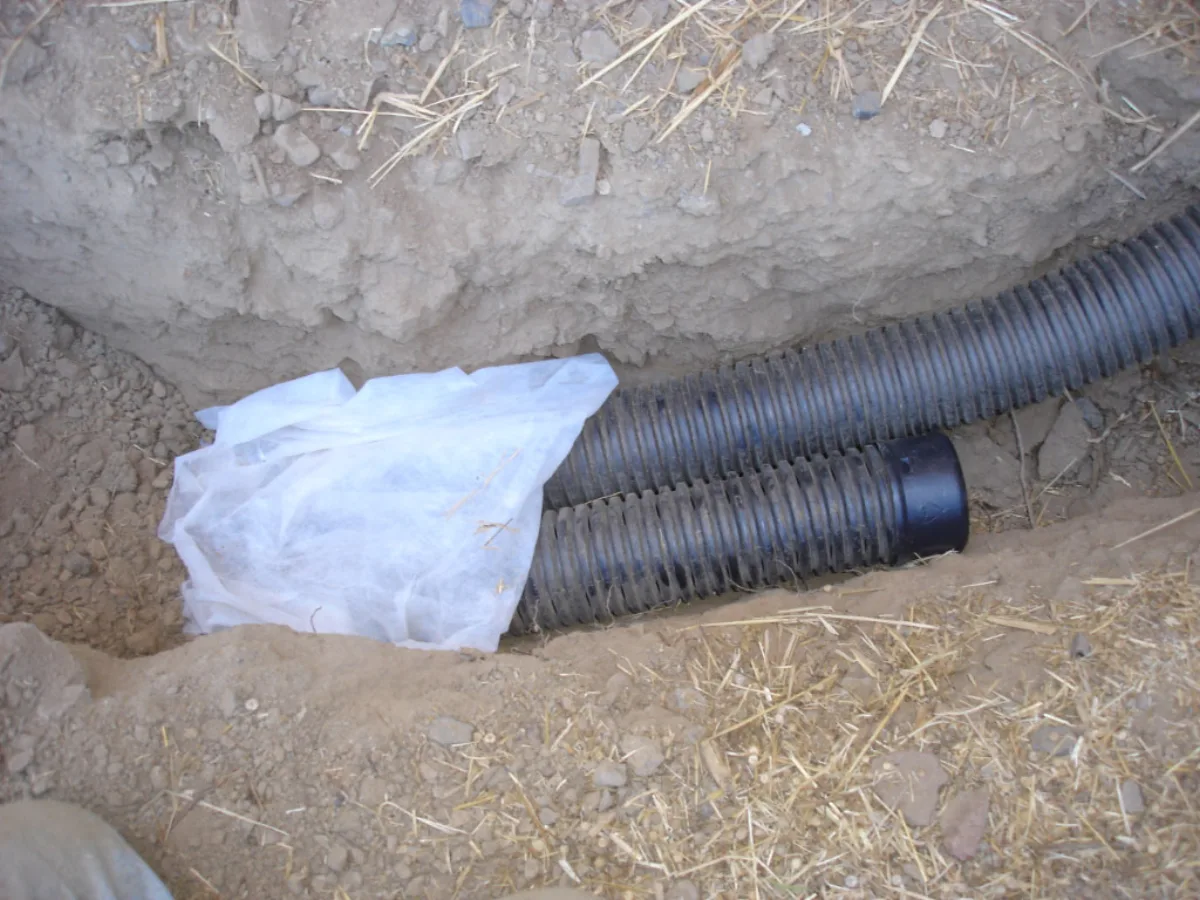
French drain installation showing perforated pipe with white geotextile filter fabric in a residential trench

Why French Drains Fail in Georgia Red Clay

A french drain built correctly for Henry County's soil lasts 20 years or more. One built with shortcuts common in sandy soils fails in one to two seasons. Three factors determine whether a system survives Georgia clay long-term.

Filter fabric specification is the most critical factor. Georgia Piedmont clay particles are fine enough to migrate through the void spaces between gravel pieces without a geotextile barrier. Over time, those fine particles fill the air pockets that allow the system to drain, reducing permeability until the gravel bed is effectively solid. We use heavy-duty non-woven polypropylene geotextile rated for clay soils — wrapped around the full assembly including the sides and bottom, not just draped over the top. Lateral clay pressure comes from every direction in a swelling soil.

Trench depthis the second failure point. A pipe installed at 8 to 12 inches in Henry County sits inside the clay horizon, which has near-zero permeability. The gravel bed fills with water that has nowhere to go because the surrounding material won’t accept it. French drains in Georgia red clay need to reach below the densest clay layer — typically 18 to 36 inches — where either a more permeable horizon exists or the outlet gradient provides enough fall to maintain gravity flow to daylight.

Outlet gradient is the third failure point. A drain needs continuous downhill fall from intake to outlet — minimum 1 inch per 8 feet. A flat run accumulates sediment in the pipe and eventually holds standing water. We verify slope with a level and confirm outlet discharge on every installation.

How We Install French Drains in Georgia Red Clay

1
Site Assessment

We walk the property, identify where water enters and concentrates, check grade, and confirm where it can legally exit. In Henry County we look at overall slope, existing drainage patterns, and available daylight points, catch basin locations, or street outlets.

2
811 Utility Marking

Required by Georgia law before any excavation. We call 811 and coordinate utility marking 48 to 72 hours before work begins. Schedule your estimate call with this lead time in mind.

3
Trenching to Proper Depth

Cecil clay french drains typically need 18 to 36 inches of depth. Shallow installations fail because the pipe sits in low-permeability clay with no drainage path. Depth is set by your outlet elevation, the clay horizon depth, and whether the system targets surface runoff or groundwater.

4
Geotextile Fabric Lining

We line the trench with heavy-duty non-woven geotextile, wrapping the full assembly including sides and bottom. This step is not optional in Georgia clay. Without rated fabric, fine clay particles clog the drain stone within one to two seasons and the system fails.

5
Clean Angular Stone Backfill

Washed crushed angular stone fills the trench around the perforated pipe. We do not use rounded pea gravel or stone with fines, both of which pack up faster in clay conditions. Angular stone maintains permeability over the long term.

6
Outlet, Surface Restore, and Flow Test

Water is routed to a daylight point, catch basin tied to storm drainage, or street outlet. We confirm continuous downhill slope, run a flow test before leaving, and restore the surface with backfill, compaction, and sod to match the surrounding yard.
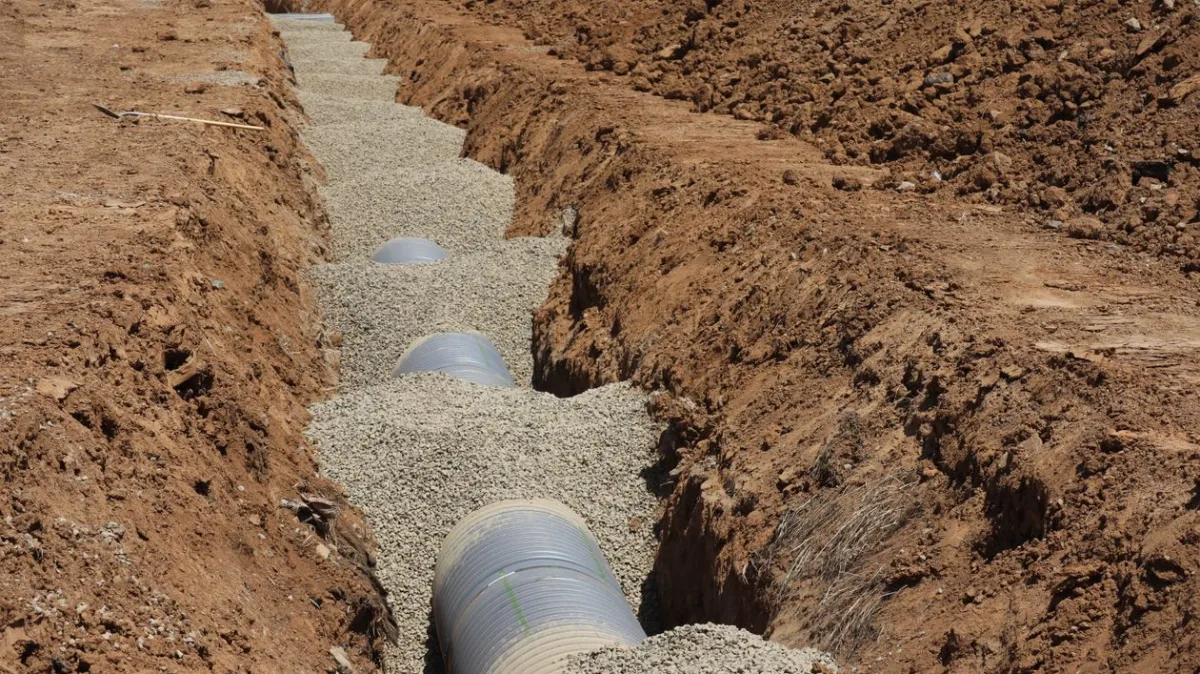
Corrugated perforated drain pipe bedded in clean angular gravel inside a residential French drain trench

French Drain Cost in McDonough GA

Pricing in Henry County reflects the additional labor and material requirements of Georgia red clay: harder trenching than sandy soils, mandatory heavy-duty filter fabric, and deeper installations than the minimum depth that works in other soil types. These ranges reflect current Henry County labor and material costs.

System TypeTypical RangeNotes
Exterior, single trench (40-60 ft)$2,500 – $4,500$25-40/linear ft; most common job type
Exterior, two-side perimeter (80-120 ft)$4,500 – $7,500Includes corner transition and outlet run
Exterior, full perimeter (150-200 ft)$7,000 – $12,000Corner lots, full yard drainage
Interior (crawl space perimeter)$40 – $55/linear ftHigher due to access and waterproofing
Catch basin + underground pipe system$3,500 – $8,000Driveways, patios, multiple inlets

Every quote is free and done on-site. Henry County clay conditions, site access, utility locations, and outlet options all affect cost in ways that can’t be estimated remotely. See our full cost guide for McDonough GA for a detailed breakdown.

Henry County Permits for French Drain Installation

Henry County requires a Land Disturbance Permit (LDP) for any clearing, grading, or leveling over 120 square feet. This is a very low threshold — most french drain projects involve trenching that easily exceeds it. Permits are applied for through the SagesGov portal. For projects disturbing one acre or more, Georgia EPD NPDES General Permit requirements also apply. See our complete Henry County Drainage Permit Guide.

How a French Drain Works

Rain saturates Georgia red clay faster than it can absorb. A properly installed system captures that water underground, routes it through gravel and perforated pipe, and carries it to a safe daylight outlet.

YARD SURFACEStanding WaterGeorgia Red ClayFilterFabricClean Angular StonePerforated PipeOutlet to Daylight
Water flow path
Geotextile filter fabric
Clean angular stone
Perforated drain pipe

French Drain Installation McDonough GA: FAQs

Questions we answer on nearly every Henry County estimate visit.

How much does french drain installation cost in McDonough GA?
Exterior french drain installation in Henry County typically runs $25 to $40 per linear foot. Interior french drains (crawl space or basement perimeter) run $40 to $55 per linear foot due to more difficult access and waterproofing requirements. Most residential projects in McDonough range from $2,500 to $9,000 total. Georgia red clay increases cost compared to sandy soils because trenching is harder and proper filter fabric specification is non-negotiable. We provide free on-site estimates with written quotes before any work begins.
Do I need a permit for a french drain in Henry County?
Yes. Henry County requires a Land Disturbance Permit (LDP) for any clearing, grading, or leveling over 120 square feet. Most french drain projects involve trenching that easily exceeds this very low threshold. Permits are applied for through the SagesGov portal at sagesgov.com/henrycounty-ga. For projects disturbing one acre or more, Georgia EPD NPDES general permit requirements also apply. We walk every project through the permit requirements during the estimate.
Does a french drain work in Georgia red clay?
Yes, when installed correctly. The two critical requirements in Georgia Piedmont clay are filter fabric and depth. Without heavy-duty non-woven geotextile wrap, fine clay particles migrate into the drain stone within one to two seasons and clog the system completely. And the pipe must reach below the clay horizon — surface-level installations stay saturated because they're sitting in low-permeability material with no outlet gradient. Installed correctly, a french drain in Henry County red clay lasts 20 years or more.
How long does french drain installation take in McDonough?
A standard single-trench residential french drain in McDonough takes one to two days from excavation through surface restore. Larger systems with multiple runs, catch basins, or downspout connections run two to three days. We call 811 to mark utilities before any excavation — factor 48 to 72 hours for utility marking when scheduling your start date.
What are the signs I need a french drain in my McDonough yard?
The most common indicators: standing water that takes more than 48 hours to drain after rain, a persistently soggy zone in the yard that stays wet between storms, water at or against the foundation after heavy rain, erosion channels where runoff has cut paths across the lawn, water entering a crawl space or garage after summer thunderstorms, and lawn that feels spongy or soft underfoot throughout the wet season. Henry County's summer thunderstorms — July averages over 5 inches — test every yard's drainage capacity.
Why does my McDonough yard stay wet for so long after rain?
Henry County sits on the Georgia Piedmont where Cecil red clay dominates the soil profile. Cecil clay has very low hydraulic conductivity — it absorbs water slowly and holds it for days. When summer thunderstorms drop an inch or more in an hour, the clay surface saturates before it can accept more water. The remainder runs across the surface or sits in low spots until it evaporates. A french drain gives that water a path out that doesn't depend on clay absorption.
Can I install a french drain myself in Henry County GA?
Homeowners do attempt DIY french drains, but Georgia red clay raises the failure rate significantly. The three most common DIY failures: incorrect filter fabric specification (fabric rated for sandy soils fails in clay), insufficient trench depth (the pipe ends up sitting in saturated clay with no outlet), and outlet routing errors (a drain that runs flat or slightly uphill holds water instead of moving it). You must also call 811 before any excavation — this is Georgia law. We're happy to discuss your specific situation during a free estimate.
When is the best time to install a french drain in McDonough GA?
Fall (October through December) is the optimal window in Henry County. The soil is drier after summer and before winter rains, making excavation faster and trench walls more stable. An installed fall system can be verified before the following spring wet season. That said, we install year-round — summer jobs are common because that's when drainage problems become obvious. Summer installation is messier in clay but produces the same result.
What is filter fabric and why does it matter in Georgia clay?
Filter fabric (geotextile) is wrapped around the gravel and pipe assembly in a french drain. It allows water through but blocks clay particles from migrating into the gravel bed. In Georgia Piedmont clay, skipping or under-specifying the fabric is the primary reason residential french drains fail early. Clay particles are fine enough to pass between gravel pieces over time, gradually filling the void space and reducing permeability to near zero. We use non-woven polypropylene geotextile rated for clay soils on every Henry County installation.
Will a french drain protect my foundation in Henry County?
Yes. Georgia red clay expands when it absorbs water and can exert significant lateral pressure against foundation walls. A perimeter french drain installed at footing depth intercepts water before it saturates the soil closest to the foundation. For new construction in McDonough's rapidly developing subdivisions — where builder grading often slopes toward the house — a perimeter drain is frequently the most protective drainage investment a homeowner can make. Foundation repair in Georgia runs $4,000 to $30,000 depending on extent; a perimeter drain is a fraction of that cost and addresses the root cause.
Ready to solve your drainage problem?

Free on-site estimate. We walk the site, diagnose the problem, give you a straight quote.

Get a Free Estimate