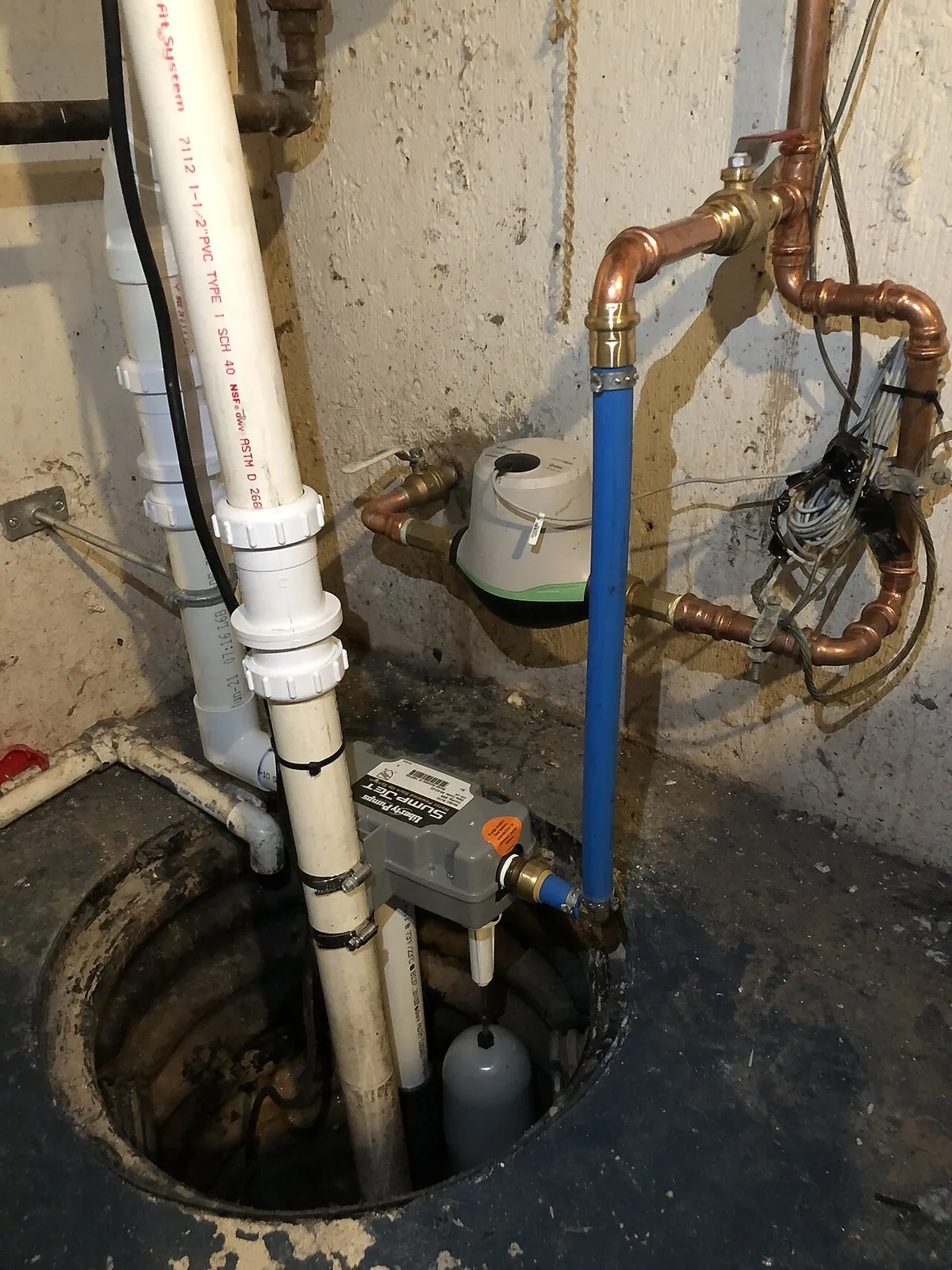
Sump Pumps in Henry County Georgia
A sump pump is the final line of defense when drainage systems have collected water that needs active removal. In McDonough crawl spaces and basements, sump systems are often the most practical solution for managing water that enters during Henry County's intense summer storm season.
Georgia averages 52 inches of rainfall annually in the metro Atlanta region, and much of that arrives in concentrated summer thunderstorms. When Georgia red clay soils saturate quickly and water has nowhere to percolate, a sump pump removes the collected water before it causes structural damage or creates conditions for mold growth.
Sump systems work best as part of a complete drainage plan. The estimate should settle whether your water problem requires a sump pump alone, or whether it needs to be combined with interior or exterior drainage to effectively intercept water before it reaches the pit.
What's Included in a Sump Pump Installation
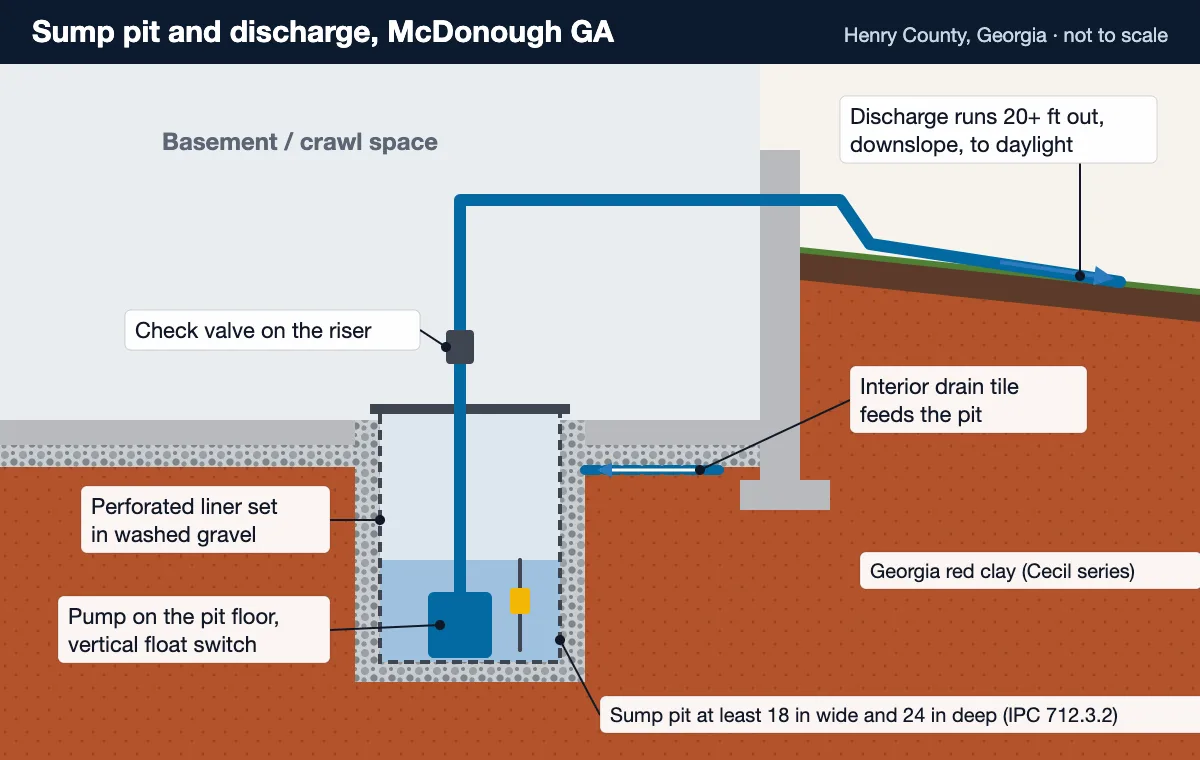
The sump pit is excavated to the required depth below the floor slab or crawl space grade. Pit diameter and depth depend on the expected water volume and the pump model.
A perforated plastic liner is set in the excavated pit to contain the gravel bed and allow water to enter the pit from surrounding soil.
Clean gravel surrounds the liner for drainage. In Georgia red clay, this layer is critical: without it, clay fines will eventually clog water entry into the pit.
The pump is sized to your expected water volume. Henry County homes with active drainage problems need a pump rated for the peak flow rates Georgia storms produce.
A discharge pipe routes pumped water away from the foundation to a safe outlet. The discharge is routed so it cannot recirculate back toward the structure.
Georgia storms that flood crawl spaces often knock out power at the same time. A battery backup sump pump continues operating through power outages. Strongly recommended for Henry County installations that deal with significant water volumes.
When Do You Need a Sump Pump?
- Water standing in crawl space after heavy rain
- Basement floor wet or seeping after significant storms
- Existing sump pump failing or undersized for current water volume
- Interior drainage system that needs an active pump to discharge
- Crawl space with vapor barrier but no active water removal system
- New construction home in Henry County low-lying area
Sizing a Sump Pump for Henry County Storm Volumes
Pump sizing starts with how much water actually shows up, not with what the box at the home center says. A 1,200 square foot crawl space under a McDonough home takes on a surprising volume during a Henry County summer storm. July here averages over 5 inches of rain, and most of it arrives in afternoon thunderstorms that drop an inch or more in under an hour. Cecil red clay absorbs somewhere between 0.1 and 0.5 inches per hour, so nearly all of that hour's rainfall moves sideways through the top of the soil profile instead of down through it. A share of it arrives at your foundation wall.
Two numbers set the specification. The first is peak inflow, measured in gallons per minute at the pit during the worst hour that lot can reasonably expect. The second is total dynamic head, which is the vertical lift from the pit floor to the discharge point plus friction loss along the run. A pump rated at 3,000 gallons per hour at zero lift may only move around 1,800 gallons per hour at ten feet of head, and most crawl space installs in McDonough involve eight to twelve feet of lift once the discharge clears the foundation and runs out to daylight. The pump gets sized on the derated number.
Where possible, inflow is measured directly by watching how fast the pit recovers during or right after a storm, and the pump is set so it runs in short cycles rather than continuously. A pump that never shuts off during a Henry County thunderstorm is undersized, and it will fail during the exact week you need it working.
Crawl Space Sumps vs Basement Sumps in McDonough
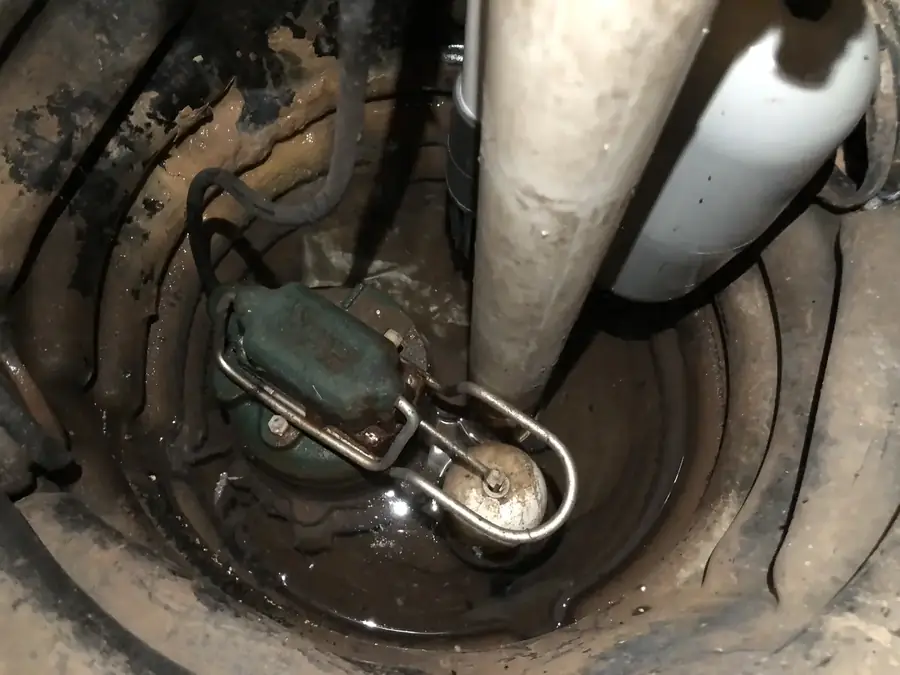
Most homes in McDonough, Ola, and Hampton sit on crawl space or slab foundations rather than full basements, and that shapes the install. In a crawl space the pit goes into the soil floor at the low corner, usually where the interior drain tile or the exterior drain outlet terminates. Headroom is the constraint. The work happens in 24 to 36 inches of clearance, which means a shallower and wider pit, and a discharge line routed along the joists before it exits through the rim.
Basement pits are more common in the older sections of Stockbridge and on the walkout lots Henry County builders put on sloped ground. There the pit goes through the slab, which means cutting concrete, excavating below the slab into the clay, and restoring the floor around the liner. It is a longer day of work, but the finished system is easier to service and the pump can sit deeper below finished floor level, which buys more storage volume before the float trips.
Slab-on-grade homes with no crawl space and no basement rarely need a sump at all. For those the answer is almost always exterior: regrading, a perimeter drain, or a catch basin system that stops water reaching the slab edge in the first place. A straight estimate will tell you that rather than sell you a pit you have no use for.
Where the Discharge Goes, and Why It Matters Here
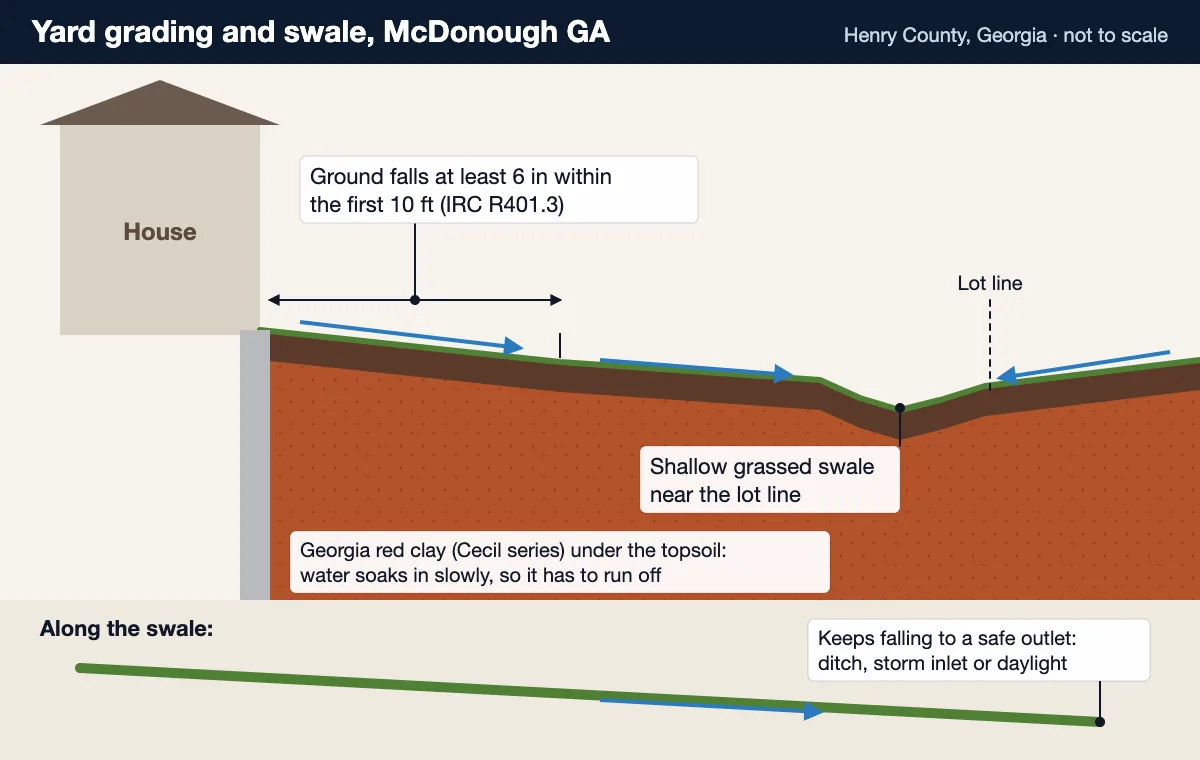
Where the pumped water lands is the part homeowners think about last and regret first. The discharge line has to end far enough from the house that the water does not simply soak back into the same saturated clay and return to the pit. In Henry County's low-permeability soil that recirculation loop is real. A discharge dumped six feet off the corner of the house will be back at the pit inside the hour during a storm, and the pump will cycle all afternoon moving the same water in a circle.
Discharge lines run to daylight wherever the lot has enough fall, typically 20 feet or more from the foundation and downslope of it. Where there is no fall, the options are a tie-in to an existing storm structure or a dry well sized to hold the peak volume. What is never an option is routing discharge across a property line onto a neighbor's lot. That creates a civil dispute, and in a county with a 120 square foot land disturbance threshold it can create a code problem too.
Every discharge riser needs a check valve. Without one, the column of water standing in the vertical run drains back into the pit each time the pump shuts off, which trips the float again a few seconds later. Short cycling is the fastest way to wear out a sump pump, and it is the single most common defect on systems installed by someone in a hurry.
What Sump Work Costs Around McDonough
Sump work in Henry County is quoted as part of a drainage system rather than as a standalone appliance swap, because a pit with nothing feeding it does very little. The interior perimeter drain that feeds the pit runs $40 to $55 per linear foot here, the same rate as an interior french drain. A 90 foot crawl space perimeter therefore lands between $3,600 and $4,950 for the drain portion alone. A partial run along only the two walls where water actually enters is often the smarter spend and cuts that figure close to half.
The pit, liner, gravel bed, pump, check valve, and discharge run are quoted separately once the access has been seen and the lift measured. Battery backup adds a second pump, a deep cycle battery, and a charger to the same pit. It is priced on site rather than off a list because access is the variable that moves the number most. A crawl space with a 30 inch hatch on the back of the house is a very different job from a walkout basement with a door, even when the pump specification is identical.
Why Sump Pumps Fail Early in Georgia Red Clay
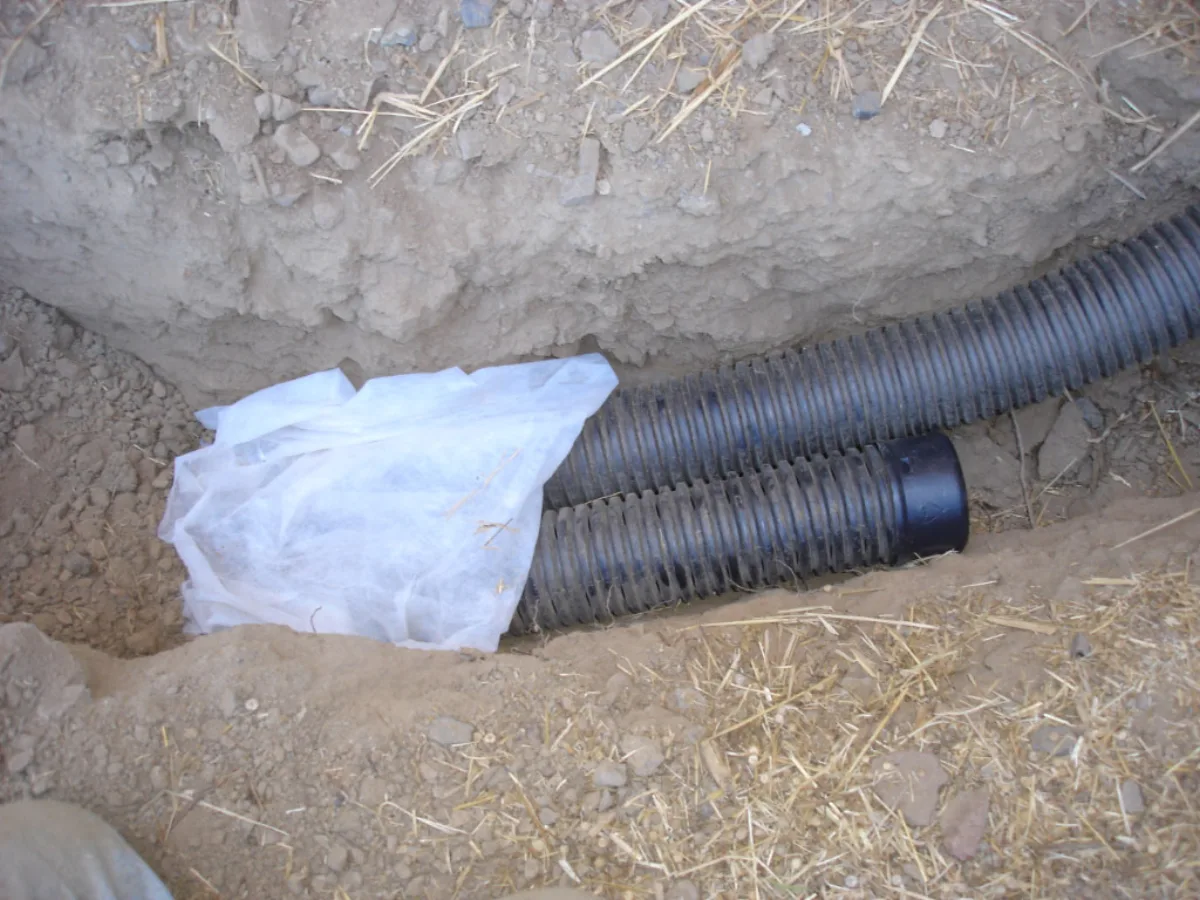
Three and four year old sump pumps fail far more often than they should. In Henry County the failure patterns are consistent, and all of them are avoidable at install time.
Clay fines in the pit. Cecil clay particles are fine enough to stay suspended in moving water, then settle out in the pit where the flow slows down. Over a few seasons that silt builds a layer on the bottom that the pump draws through on every cycle, grinding the impeller and the shaft seal. A pit with a proper gravel bed and a perforated liner filters most of it out. A pit that is just a hole with a bucket dropped in it does not.
Float switch failure. Tethered floats hang up on the pit wall or on the discharge pipe. Stuck on, the pump runs dry and burns out. Stuck off, you find out during the storm. A vertical float switch in a correctly sized liner removes most of that risk, and it costs very little more at install.
No backup power. The Georgia thunderstorms that flood a crawl space are the same storms that drop the power lines along GA-20 and GA-42. The pump you need most is the one that stops when the lights go out. On any system protecting a finished basement in Henry County, a battery backup unit is basic equipment rather than an upgrade.
Undersized for real inflow. A one third horsepower pump chosen because it matched the last one, sitting on a lot that now receives runoff from two new-construction yards uphill, will run continuously through every storm and fail inside two seasons. Henry County adds close to 7,000 homes a year, and an uphill subdivision changes the water budget of every lot below it.