Drainage in Hampton GA

Hampton is in southern Henry County, along the GA-20 and US-19 corridors south of McDonough. Like the rest of Henry County, Hampton sits on Georgia's Piedmont Cecil red clay, and its drainage problems follow the same pattern: slow-permeability clay soil, heavy summer thunderstorms, and new construction grading that sends water in the wrong direction.
The Hampton area has seen significant residential growth as Henry County's development has pushed south along the I-75 corridor toward Locust Grove and beyond. New subdivisions in Hampton bring the same issues as those closer to McDonough: rushed final grading, insufficient drainage installation at construction, and homeowners discovering problems within a few years of move-in.
Hampton is part of the Henry County service area, with the same free estimate as McDonough.
Why Hampton Lots Drain Differently From North Henry County
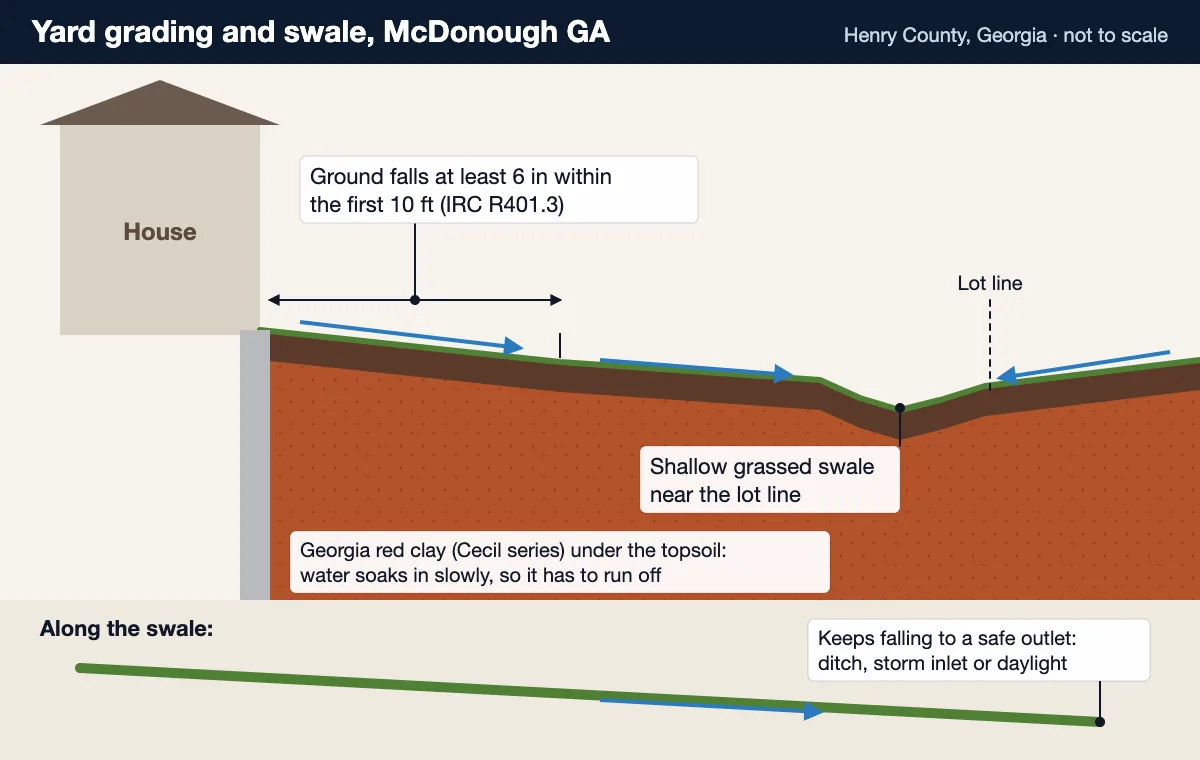
Henry County straddles two drainage basins. The north end around Stockbridge sheds into Cotton Indian Creek and the South River, headed for the Ocmulgee. The Hampton side of the county falls the other way, toward Bear Creek and the Flint. That split matters less for the rules than it does for the shape of the ground. North Henry is cut into steeper Piedmont hillsides, so builders there create level pads by cutting into a slope and filling out the downhill side. Around Hampton the terrain flattens out, and flat ground on Cecil clay is the combination that leaves water sitting for two or three days after a storm instead of running off in an afternoon.
The practical consequence is that Hampton drainage jobs are more often about finding fall than about handling volume. On a McDonough hillside there is usually somewhere obviously downhill to send the water, and the question is how to intercept it. On a flat Hampton lot off Bethsaida Road or Panhandle Road the water is not going anywhere fast in any direction, and the whole estimate turns on whether there is enough drop across the property to run a gravity line to a daylight point. With metro Atlanta averaging around 52 inches of rain a year and most of it arriving in intense summer bursts, a system with marginal fall will back up exactly when you need it.
Lot size is the other difference. Hampton still has a lot of unincorporated acre-plus parcels, and an acre of Cecil clay sheds a serious amount of water in a July thunderstorm. On those properties the runoff has usually concentrated into a defined channel well before it reaches the house, which means the right move is interception partway up the slope rather than a single basin at the bottom. A basin placed at the low corner of a one-acre Hampton lot will be overwhelmed by the second storm of the season.
Services Available in Hampton GA
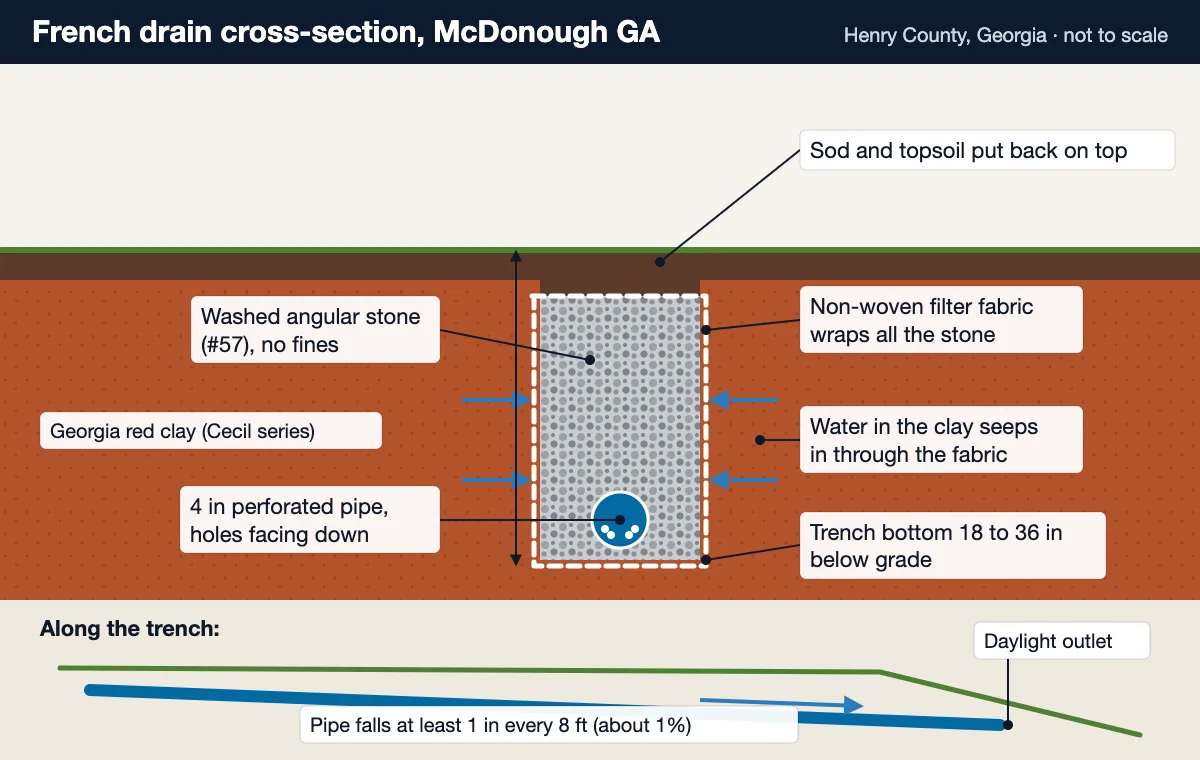
Exterior and interior french drain systems engineered for Henry County clay. Trenched to the right depth, with the correct filter fabric specified for Cecil soil conditions.
Catch basins, channel drains, and swale grading for Hampton yards with standing water problems after Georgia summer rain events.
Exterior and interior perimeter drainage for Hampton homes with water pressure against foundation walls from Georgia red clay saturation.
Sump pit and pump systems for Hampton crawl spaces and basements. Battery backup options for Georgia storm season power outages.
Areas Covered In and Around Hampton
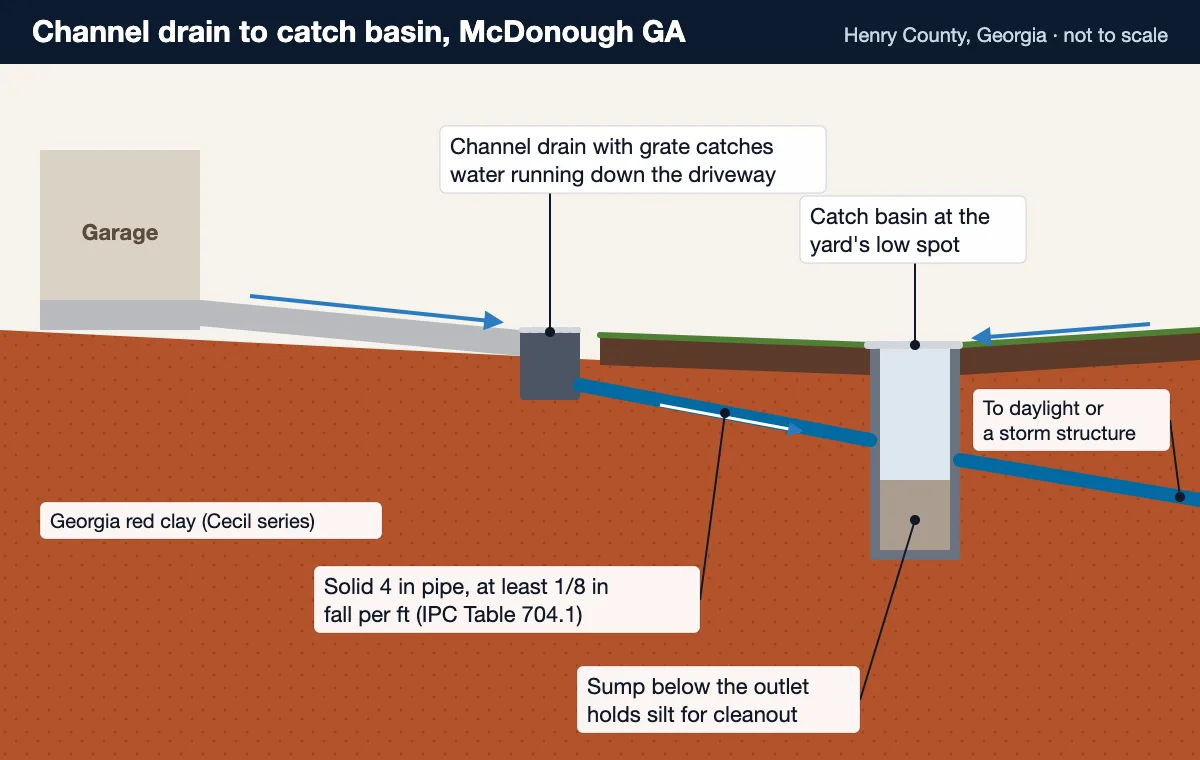
Hampton drainage problems spread across the GA-20 and GA-81 corridors, the US-19 and US-41 spine that runs through the middle of town, and the residential streets off Bear Creek Boulevard and Lovejoy Road. The newer subdivision pockets near the Atlanta Motor Speedway and out toward Nash Farm Battlefield produce the classic Henry County new-build complaint: a pad that was cut and filled to sit level, fill that settles over the first two or three seasons, and a shallow bowl that forms along one side of the house where the downspouts land.
Older Hampton properties closer to the town center fail for the opposite reason. Decades of added mulch and topsoil around beds, a driveway replaced at a higher elevation than the original, and mature trees lifting the grade all conspire to trap water against the foundation. Those jobs usually cost less than the homeowner is braced for. A channel drain at the garage apron plus two buried downspout extensions running to a daylight point will resolve what looked from the back door like a whole-yard problem. A straight estimate says so rather than selling a perimeter system that the lot does not need.
Henry County Permits Apply in Hampton
Hampton is within Henry County, so the county's land disturbance permit (LDP) requirement applies: any grading, clearing, or leveling over 120 square feet requires a permit. Most drainage projects exceed this threshold. Permits are applied for through the SagesGov portal.
To put 120 square feet in perspective, that is a patch roughly 10 feet by 12 feet. A 60-foot trench two feet wide clears it three times over. The threshold is one of the lowest in metro Atlanta, and it exists because Henry County has spent more than a decade absorbing roughly 6,900 new homes a year and the stormwater that comes with them. The reviewing department is Henry County Environmental Inspections and Compliance, and it is the same office whether the property is in Hampton, Stockbridge, or unincorporated McDonough.
Two things on top of the LDP catch Hampton properties specifically. If the lot backs onto a creek or sits in a low-lying bottom, check the address against the FEMA Flood Map Service Centerbefore anyone puts a shovel in the ground, because a Special Flood Hazard Area designation can bring a separate floodplain development permit from the county's Building and Plan Review department. And if the drainage work is bundled into a larger regrade that disturbs an acre or more, a Georgia EPD NPDES construction permit enters the picture and Henry County will want a copy of the Notice of Intent with the application. Neither is common on a single-family drainage job, but both are cheaper to check than to unwind.
What a Hampton Drainage Estimate Includes
Hampton drainage is not quoted over the phone, and the reason is the outlet. Two identical soggy patches, one 30 feet from a downhill daylight point and one 140 feet from the nearest place the water can legally go, are not the same job and will not be the same number. So the visit starts at the low end of the property rather than at the wet spot. The contractor finds where the water can legally exit, then works backwards to the collection.
What is not a legal outlet is the lot next door. Concentrating collected runoff and pushing it across a property line is a civil liability in Georgia and a fast way to fall out with a neighbor. On the flatter Hampton parcels where gravity genuinely runs out, the honest answer is sometimes storage plus a pump rather than a gravity line, and a straight estimate will tell you that instead of installing a pipe that holds water. The written quote names the pipe type, the trench depth, the stone, the geotextile fabric spec, and the outlet location, because in Cecil clay a system that skips the filter fabric silts up and fails inside two or three seasons.