Henry County, GA • Soil Guide
Georgia Red Clay Drainage: A Henry County Homeowner's Guide
Why Cecil red clay causes chronic drainage problems across McDonough, Stockbridge, and Hampton, and what properly installed french drains do to solve them.
What Is Cecil Clay and Why Does It Cause Drainage Problems?
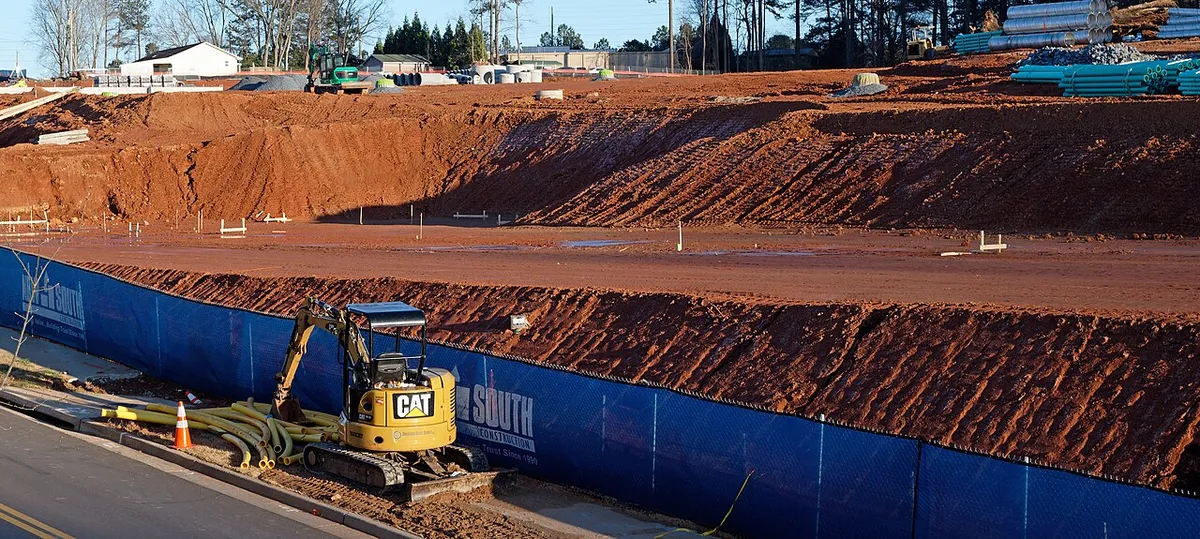
Henry County sits in Georgia's Piedmont physiographic region, where the dominant soil series is the Cecil clay series. Cecil soils are the most widespread soils on the Georgia Piedmont, covering large portions of the state's middle belt from the fall line to the Blue Ridge foothills. The characteristic red or reddish-brown color comes from iron oxide concentrations in the clay fraction.
The USDA classifies Cecil clay as "well-drained," which is technically accurate but misleading for homeowners. That classification describes water movement through the full soil profile over time. What it doesn't describe is the surface and near-surface behavior during intense rainfall events, which is where the practical drainage problem lies.
Cecil clay has very low hydraulic conductivity. Water moves through it slowly. During Henry County's intense summer thunderstorms, which can deliver two to four inches of rain in an hour, the clay surface saturates much faster than it can absorb. The result is surface ponding, sheet flow, and water backing up against any low point or structure in the landscape.
The New Construction Problem in Henry County
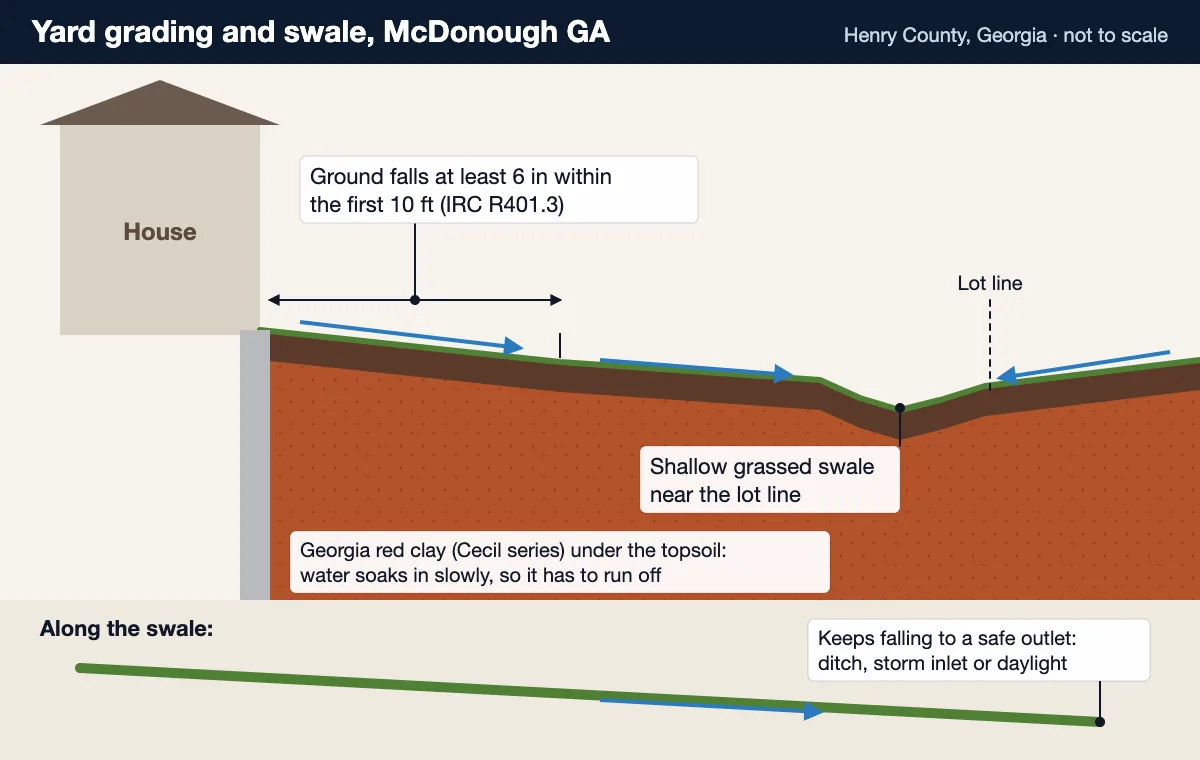
Henry County has been one of metro Atlanta's fastest-growing counties for over a decade, adding close to 7,000 new homes per year along the I-75 corridor east and south of the highway. Rapid subdivision construction creates a specific drainage problem pattern that shows up regularly in McDonough, Stockbridge, and Hampton: improper final grading.
When builders rush final grading, they sometimes leave grades that appear to slope away from the foundation but actually direct sheet flow back toward the house after the soil settles and the lawn establishes. The problem doesn't show up immediately. It becomes visible in year one through three, when the first sustained Georgia rain season reveals which direction the water actually moves.
Henry County's rapid growth rate also means large volumes of disturbed soil throughout the county, which temporarily loses structure and drains differently than undisturbed land. New subdivision construction upstream from existing properties redirects surface runoff in ways that affect neighbors who previously had no drainage issues.
How French Drains Work in Georgia Red Clay
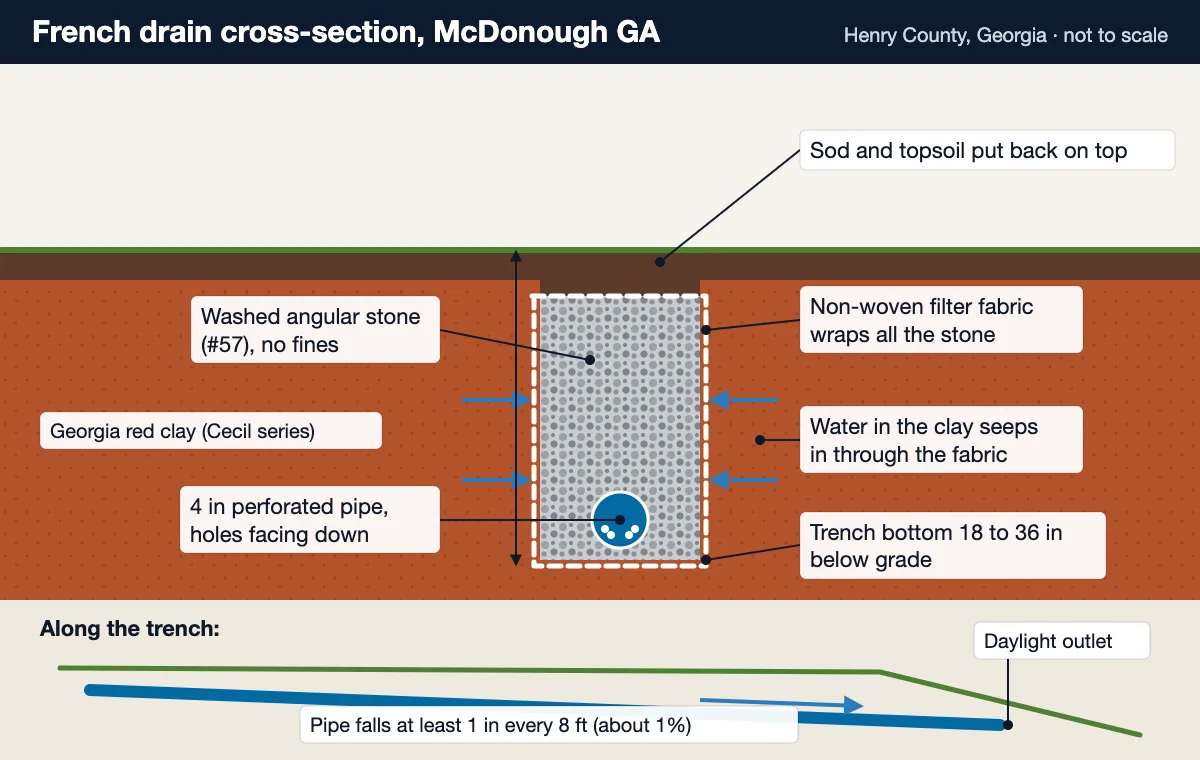
A french drain intercepts water by providing a preferred path through a permeable stone bed and perforated pipe, directing it to an outlet rather than allowing it to saturate soil and back up against structures. In Cecil clay, this works because the trench is excavated through the low-permeability clay layer and backfilled with clean crushed stone that has dramatically higher permeability.
The critical installation requirement in Georgia red clay is geotextile filter fabric. Without it, fine clay particles migrate into the drain stone over time, filling the void spaces and eventually restoring the low permeability of the surrounding clay. This process, called clay migration or fines migration, is the primary failure mode of french drains installed without proper fabric in Georgia Piedmont soils.
A properly specified heavy-duty non-woven geotextile filter fabric, wrapped around the stone and pipe assembly, allows water to pass freely while blocking clay fines. Installations using the correct fabric in Henry County conditions have lifespans measured in decades, not seasons.
Depth also matters in Georgia red clay. The trench must reach below the clay horizon to where the stone backfill can actually receive water and transmit it to the outlet. Surface-level installations in Cecil clay fail because the pipe ends up surrounded by saturated low-permeability clay with nowhere to drain. Typical effective depth in Henry County is 18 to 36 inches depending on the specific site.
Cecil Clay vs. Sandy Soils: Why Georgia Installs Cost More
| Factor | Sandy Soil | Georgia Red Clay |
|---|---|---|
| Trench difficulty | Easy, fast | Hard, slow |
| Required depth | 12-18 inches typical | 18-36 inches typical |
| Filter fabric | Basic woven fabric | Heavy non-woven required |
| Stone specification | Standard drain rock | Clean angular stone, no fines |
| System lifespan without fabric | Several years | 1-2 seasons |
| Cost vs. sandy areas | Baseline | 15-30% higher |
Every drainage problem is site-specific. A vetted local contractor comes out, walks the property, works out where water is coming from and where it can go, and gives you a straight quote. No obligation, no fee.